Elba, in Tuscany, is Italy's third-largest island after Sicily and Sardinia, and the largest island of the Tuscan Archipelago, a group of islands off the Italian mainland. Lying about 10 km from Piombino, it covers 244.99 km² and has just over 31,000 inhabitants spread across seven municipalities; its main town, Portoferraio, accounts for about 11,700 of them. Its highest point, Monte Capanne, rises to 1,018 m. Mined since Etruscan times, iron made the island famous: the Greeks called it Aethalia, "the smoky one". Napoleon I was exiled there from 4 May 1814 until 26 February 1815, when he left for France.
Florence (Firenze) is the capital of Tuscany. The city covers 102.32 km² and has about 361,600 inhabitants. Many historians regard it as the birthplace of the Renaissance. The Medici ruled there: Alessandro became duke in 1531, Cosimo I grand duke of Tuscany in 1569, and the dynasty ended in 1737 with Gian Gastone. Santa Maria del Fiore cathedral, begun in 1296 to a design by Arnolfo di Cambio, was structurally complete by 1436, with the dome by Filippo Brunelleschi. The Ponte Vecchio, rebuilt in the 14th century, is the only bridge in the city to have survived the Second World War intact. The historic centre has been a UNESCO World Heritage Site since 1982.
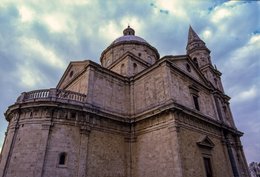
Montepulciano is a municipality in the province of Siena, Tuscany, perched at an elevation of 605 m. It covers 165.33 km² and had 13,984 inhabitants at the end of 2017. A settlement existed there as early as the 4th-3rd centuries BC; a loyal ally of Florence from 1390, the town reached its peak in the Renaissance, when Sangallo, Vignola and Peruzzi built sumptuous residences there. The sanctuary of the Madonna di San Biagio, circular in plan and crowned by a large dome, was designed by Antonio da Sangallo the Elder between 1518 and 1545. Its red wine, Vino Nobile, holds DOCG status.
Monticiano is a small municipality in the province of Siena, Tuscany, at an elevation of 375 m. It covers 109.5 km² and had 1,543 inhabitants at the end of November 2017. Its castle is first mentioned in 1171, under the authority of the bishop of Volterra. In 1266, Sienese troops occupied the town and destroyed its walls; it became part of the Grand Duchy of Tuscany in 1554. Among its hamlets is Bagni di Petriolo, known for its thermal waters. In 1860, its 723 inhabitants voted unanimously to join the Kingdom of Italy. A night battle against the Germans took place there on 3-4 June 1944.
Pienza is a municipality in the province of Siena, Tuscany, at an elevation of 491 m, in the Val d'Orcia. It covers 122.96 km² and had 2,091 inhabitants in February 2017. Pope Pius II, who was born there, had it rebuilt from 1459 by the architect Bernardo Rossellino; he consecrated the cathedral on 29 August 1462. Piazza Pio II brings together the Palazzo Piccolomini, the cathedral, the bishop's palace built by Cardinal Rodrigo Borgia and the town hall. Pienza's historic centre has been a UNESCO World Heritage Site since 1996; the whole Val d'Orcia was added in 2004 as a cultural landscape.
Siena is a municipality in Tuscany and the capital of the province of the same name. It covers 118.53 km² and has about 53,200 inhabitants. Its historic centre has been a UNESCO World Heritage Site since 1995. Piazza del Campo, a shell-shaped square, hosts the Palio twice a year, on 2 July and 16 August: ten of the seventeen contrade compete in the race. The cathedral's main façade was completed in 1380; the Black Death and scarce funds cut short a planned enlargement. A rival of Florence, Siena, after eighteen months of resistance, surrendered to Spain on 17 April 1555, ending the Republic.
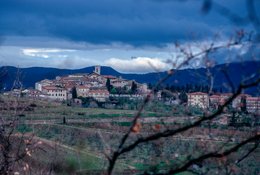
Radda in Chianti, the village under a stormy sky
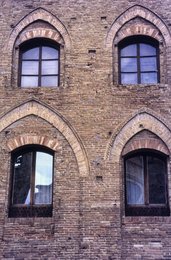
San Gimignano, brick façade and windows under pointed arches
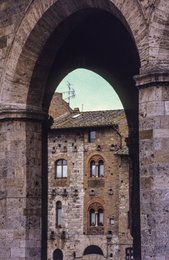
San Gimignano, brick houses seen through a great arch
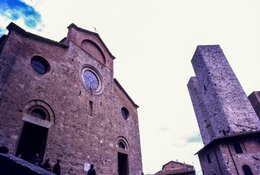
San Gimignano, façade of the Collegiate Church of Santa Maria Assunta
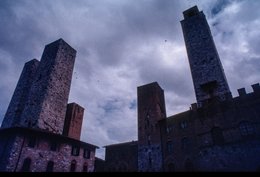
San Gimignano, silhouetted towers under a threatening sky
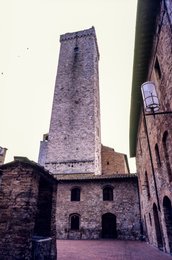
San Gimignano, stone tower above a brick-paved courtyard
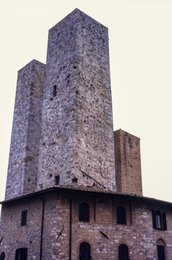
San Gimignano, twin stone towers above the roofs
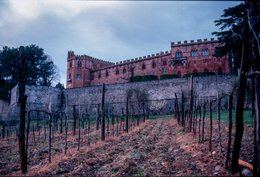
San Regolo, Brolio Castle above the vineyards
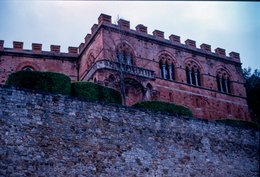
San Regolo, Brolio Castle, crenellated brick façade



 "Get Link")


 "Get Link")
 "Get Link")
 "Get Link")
 "Get Link")
 "Get Link")
 "Get Link")
 "Get Link")
 "Get Link")