Apulia (Puglia) is a region of south-eastern Italy whose capital is Bari. It covers 19,540.90 km² and has about 3.87 million inhabitants. It consists of one metropolitan city, Bari, and five provinces: Barletta-Andria-Trani, Brindisi, Foggia, Lecce and Taranto. The region has the longest coastline of any mainland Italian region. The Salento peninsula forms the "heel" (tacco) of Italy's boot. Apulia accounts for about 40% of Italy's olive oil production. Near Andria stands Castel del Monte, a building of Frederick II, who also resided in Foggia. In 216 BC, the Roman army suffered its worst defeat in the region, at Cannae, against Hannibal. The highest point, Monte Cornacchia, reaches 1,152 m.
Basilicata, known as Lucania in antiquity, is a region of southern Italy whose capital is Potenza. It covers about 10,073 km² and has about 525,000 inhabitants, a density of about 52 per km². It consists of two provinces, Potenza and Matera. The Sassi of Matera have been a UNESCO World Heritage Site since 1993, and Matera was European Capital of Culture in 2019. The region has a 30 km stretch of coast on the Tyrrhenian Sea, in the Gulf of Policastro, where Maratea is the main seaside resort, and a longer coastline on the Ionian Sea, in the Gulf of Taranto. Pollino National Park is the largest national park in Italy.
Campania is a region of southern Italy whose capital is Naples. It covers 13,670.95 km² and has about 5.57 million inhabitants. It comprises four provinces (Avellino, Benevento, Caserta, Salerno) and the Metropolitan City of Naples. It is home to ten of Italy's 58 UNESCO sites, including Pompeii, Herculaneum, the Royal Palace of Caserta, the Amalfi Coast and the Historic Centre of Naples. Vesuvius, which rises to 1,281 m, buried Pompeii and Herculaneum in 79. Euboean Greeks founded Cumae, Pithekoūsai and Paestum there in the 8th century BC. In 1815, the Congress of Vienna combined the kingdoms of Naples and Sicily into the Kingdom of the Two Sicilies.
Latium (Lazio) is a region of central Italy whose capital is Rome, also the country's capital. It covers about 17,232 km² and has about 5.71 million inhabitants. It comprises four provinces, Frosinone, Latina, Rieti and Viterbo, and the Metropolitan City of Rome Capital. Its name comes from the Latin Latium, the land of the Latins; a modern explanation links it to latus, "wide", describing its flat land. Rome, the most visited city in Italy, receives around 30 million visitors a year. The region is home to the Colosseum, Ostia Antica, Hadrian's Villa, Villa d'Este and Monte Cassino Abbey. Italian is the region's only official language.
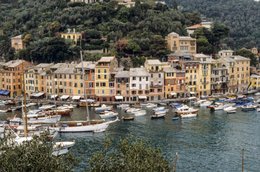
Liguria is a region of north-western Italy, a narrow, arched strip between the sea, the Alps and the Apennines, from Ventimiglia to La Spezia. The third-smallest Italian region after Aosta Valley and Molise, it covers 5,416 km² and has about 1.51 million inhabitants. Its capital is Genoa, a metropolitan city of 820,691 inhabitants; the other three provinces are Imperia, Savona and La Spezia. About 65% of the territory is mountainous; Monte Saccarello rises to 2,201 m. The Italian Riviera stretches along about 350 km of it. Its territory roughly matches that of the former Republic of Genoa, a major Mediterranean maritime power from the 12th to the 14th century. Pesto originated here.
Sardinia (Sardegna) is the second-largest island in the Mediterranean, after Sicily. An autonomous region, one of five in Italy with statutory autonomy, it covers 24,100 km² and has about 1.55 million inhabitants. Its capital is Cagliari; it has six provinces and two metropolitan cities. Its coastline runs for 1,849 km and its highest point, Punta La Marmora, reaches 1,834 m. The Nuragic civilisation flourished there from the 18th century BC until 238 BC, and later in some areas, leaving about 7,000 nuraghi, stone towers that still mark the island's landscape. In the Barbagia area, this culture lasted until the 6th century.
Tuscany (Toscana) is a region of central Italy. It covers 22,987 km² and has about 3.66 million inhabitants. Its capital is Florence, which forms a metropolitan city with its surroundings; the region also includes nine provinces. It is regarded as the birthplace of the Italian Renaissance. Etruscan civilisation peaked there in the 7th and 6th centuries BC. Tuscany has eight UNESCO World Heritage localities in all, among them the historic centres of Florence, Siena and Pienza. Chianti is a renowned red wine from the region, alongside several other celebrated Tuscan wines. The Tuscan Archipelago, of which Elba is the most significant island, lies off its coast.
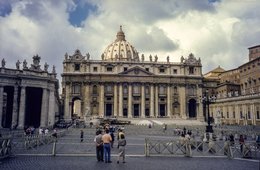
Vatican City is the smallest state in the world by both area and population. Enclosed within the city of Rome, it covers 44 hectares, or 0.49 km², and had 882 inhabitants according to a 2024 estimate. Its independence rests on the Lateran Treaty, signed on 11 February 1929 and in force from 7 June 1929. A Constantinian basilica was built there in 326 over the believed tomb of Saint Peter. The Sistine Chapel, part of the Vatican Museums, holds frescoes by Perugino, Ghirlandaio and Botticelli, as well as Michelangelo's ceiling and Last Judgment. The Swiss Guard was founded on 22 January 1506 by Julius II. Vatican City has been a UNESCO World Heritage Site since 1984.
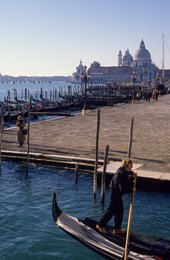
Veneto is a region of north-eastern Italy whose capital is Venice. It covers about 18,345 km² and has about 4.86 million inhabitants. It comprises the provinces of Belluno, Padua, Rovigo, Treviso, Verona and Vicenza, plus the Metropolitan City of Venice. Verona, the largest city, has 255,139 inhabitants; Padua, 208,202, with a university founded in 1222. The highest massif in the Dolomites, Marmolada, reaches 3,342 m, with the Tre Cime di Lavaredo and the Pale di San Martino. The Republic of Venice ended in 1797, when Napoleon invaded and the doge resigned. Prosecco is produced around Conegliano and Valdobbiadene. Veneto is the first region in Italy in terms of tourist presence.
Field of sunflowers
Italy, artisanal Apulian pasta in bags, prices in lire
Italy, artisanal pasta in bags, close-up
Italy, heap of garlic on a stall, “Mercatino della frutta”
Italy, stall of chillies, garlic, lemons, fruit and vinegars
Italy, strings of red chillies and “Viagra naturale” sign




 "Get Link")


 "Get Link")

 "Get Link")

 "Get Link")

 "Get Link")

 "Get Link")

 "Get Link")

 "Get Link")

 "Get Link")


