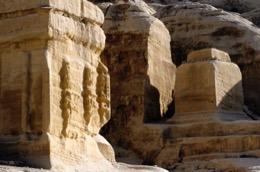
Le tombeau aux Obélisques est un monument nabatéen situé dans le secteur de Bâb as-Sîq, à l'entrée du site de Pétra, en Jordanie. Édifié au Ier siècle de notre ère, il se compose de deux niveaux superposés : à l'étage supérieur, quatre pyramides effilées appelées « nefesh », motif symbolisant l'âme des défunts, encadrent une niche centrale abritant une figure drapée ; à l'étage inférieur, un triclinium à façade dorique servait de salle de banquet funéraire en l'honneur des défunts. Une inscription nabatéenne et grecque, encore visible, commémore la construction du tombeau par un certain Abdmanku pour lui-même et ses descendants. Ce monument atypique, mêlant traditions funéraires locales et influences hellénistiques, marque l'un des premiers repères architecturaux rencontrés avant l'entrée du Sîq.
Le Sîq, gorge naturelle constituant l'accès principal à Pétra en Jordanie, était doublé sur toute sa longueur d'un système hydraulique nabatéen sophistiqué. Des canaux taillés dans la roche, complétés par des conduites en terre cuite sur certains tronçons, acheminaient l'eau potable des sources de Wadi Musa jusqu'au cœur de la cité, tandis que des barrages de rétention aménagés dans cinq gorges latérales protégeaient le passage des crues soudaines du Wadi Musa. Ce dispositif, l'un des plus aboutis du monde antique en matière de gestion de l'eau en zone désertique, permit aux Nabatéens de garantir l'approvisionnement d'une ville prospère malgré un climat aride. Les vestiges de ces canalisations demeurent visibles aujourd'hui le long des parois du défilé.
À mi-parcours du Sîq, à Pétra en Jordanie, subsistent les vestiges érodés d'une sculpture monumentale représentant une scène de caravane : deux chameliers, vêtus d'une tunique plissée, guident chacun deux dromadaires en s'appuyant sur de longs bâtons, se faisant face de part et d'autre d'un ravin où s'écoulait un torrent saisonnier considéré par les Nabatéens comme le signe d'une présence divine. Dégagée en 1997 de l'épaisse couche de limon qui la recouvrait, cette sculpture grandeur nature témoigne du rôle du Sîq comme voie caravanière sur les routes commerciales reliant l'Arabie à la Méditerranée. Une autre représentation similaire, plus effacée, se trouve près de la sortie du défilé, rappelant l'arrivée des caravanes aux portes de la cité nabatéenne.
Le long des parois du Sîq, à Pétra en Jordanie, environ soixante-dix niches votives ont été recensées, creusées dans le grès rose par les Nabatéens pour y accueillir des bétyles, pierres dressées symbolisant leurs divinités. Les deux dieux les plus fréquemment représentés sont Dushara, divinité tutélaire de la ville associée à la fertilité, et Al-Uzza, déesse de l'amour et de la protection. Certains bétyles portent des yeux stylisés et un nez schématique évoquant un visage, tandis que de petites cavités destinées à des offrandes d'encens accompagnent souvent ces niches. Plusieurs inscriptions grecques gravées à proximité mentionnent le nom des donateurs. Ce parcours sacré ponctuait le trajet des caravaniers d'étapes spirituelles avant leur entrée dans la cité.



 "Obtenir lien")


 "Obtenir lien")

 "Obtenir lien")

 "Obtenir lien")

 "Obtenir lien")

 "Obtenir lien")

 "Obtenir lien")

 "Obtenir lien")

 "Obtenir lien")